Sometimes they become products. Sometimes operational systems. Sometimes entirely new businesses.
Over the last 20 years I've applied the same methodology across manufacturing, startups, AI, digital products and operations — turning ambiguity into systems that scale.
Role: Product Owner & end-to-end builderSoloNode backend · Web UI · Claude + GPT APIs
Agent Loop
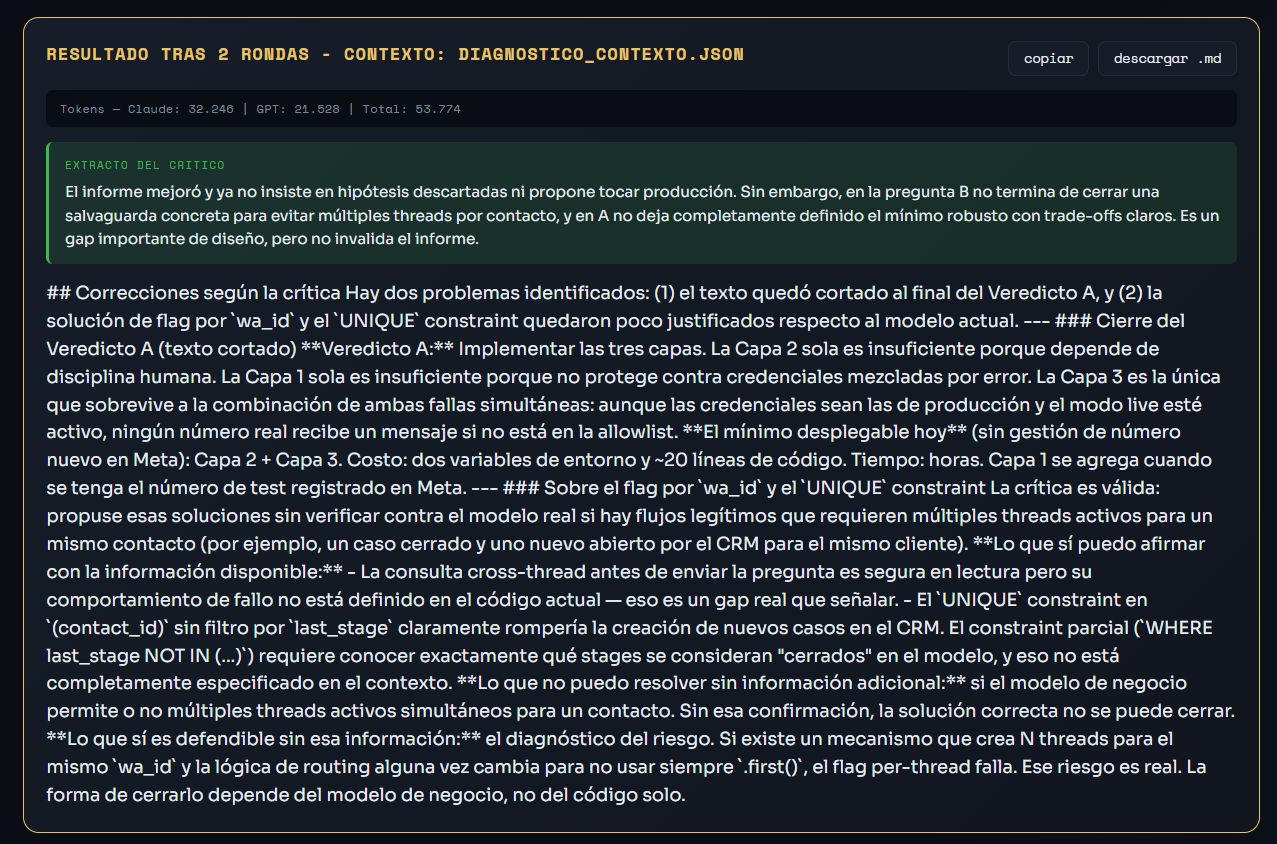
An AI-orchestration tool that makes two models from different providers (Claude and GPT) argue in an adversarial loop: one generates, the other audits, and the system iterates until it converges on a refined result.
Product walkthrough
The problem
Working with several AIs daily means jumping between windows, copy-pasting output from one into another, with no structured way to make them contrast. Worse: each model has blind spots, and used in isolation they share them. A single model reviewing its own output isn't rigorous — quality jumps when one model audits another's work.
My decisions (scope & product)
Anchored the whole thing in a real pain from my own workflow, not a technology looking for a use.
Ruthless scoping: validate the core hypothesis (cross-model critique) before building features.
Chose the most demonstrable use case — adversarial dialogue over technical analysis — as the spearhead.
How I orchestrated it
A generate → critique → correct loop between two providers, iterating to convergence.
A graded-severity system (critical / medium / trivial) replacing binary approve-reject — because the critic never approved. That's system design, not UI.
A loop detector measuring how much the output changes per round, distinguishing "needs elaboration" from "needs more information".
Live token + cost counter, and smart context pre-processing that compresses large files before hitting API limits.
What shipped
A working web app: a Node backend acting as orchestrator and secure proxy to both APIs (solving credential isolation and browser limits), and a web interface showing the dialogue in real time as a readable vertical timeline, round by round, with export of the final result.
Walkthrough
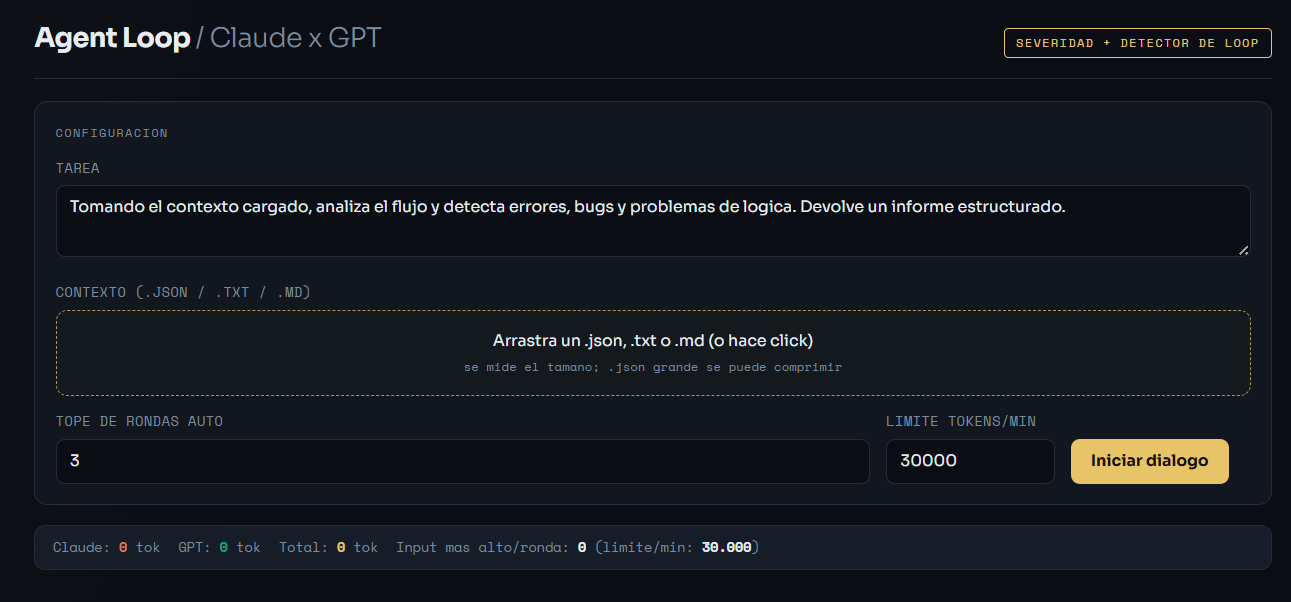
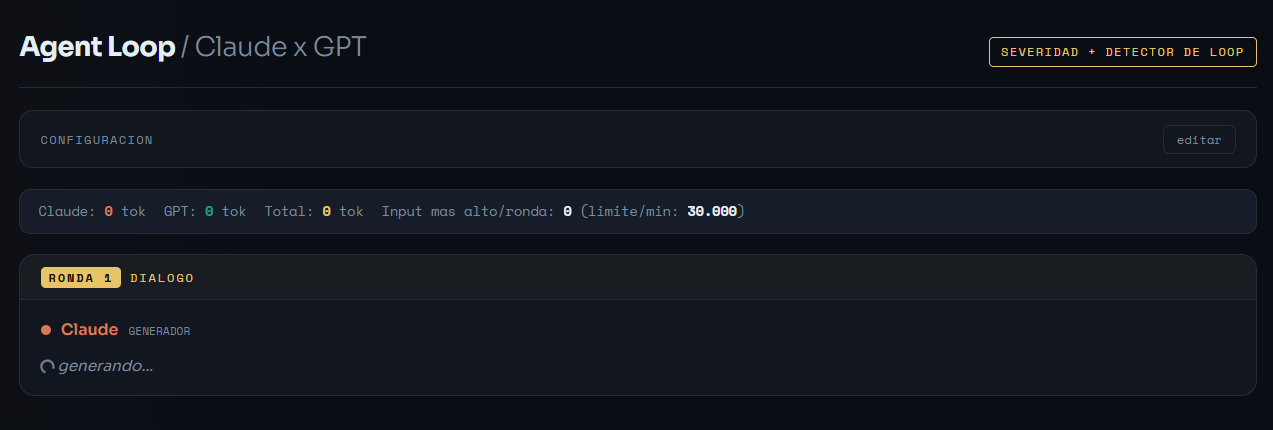
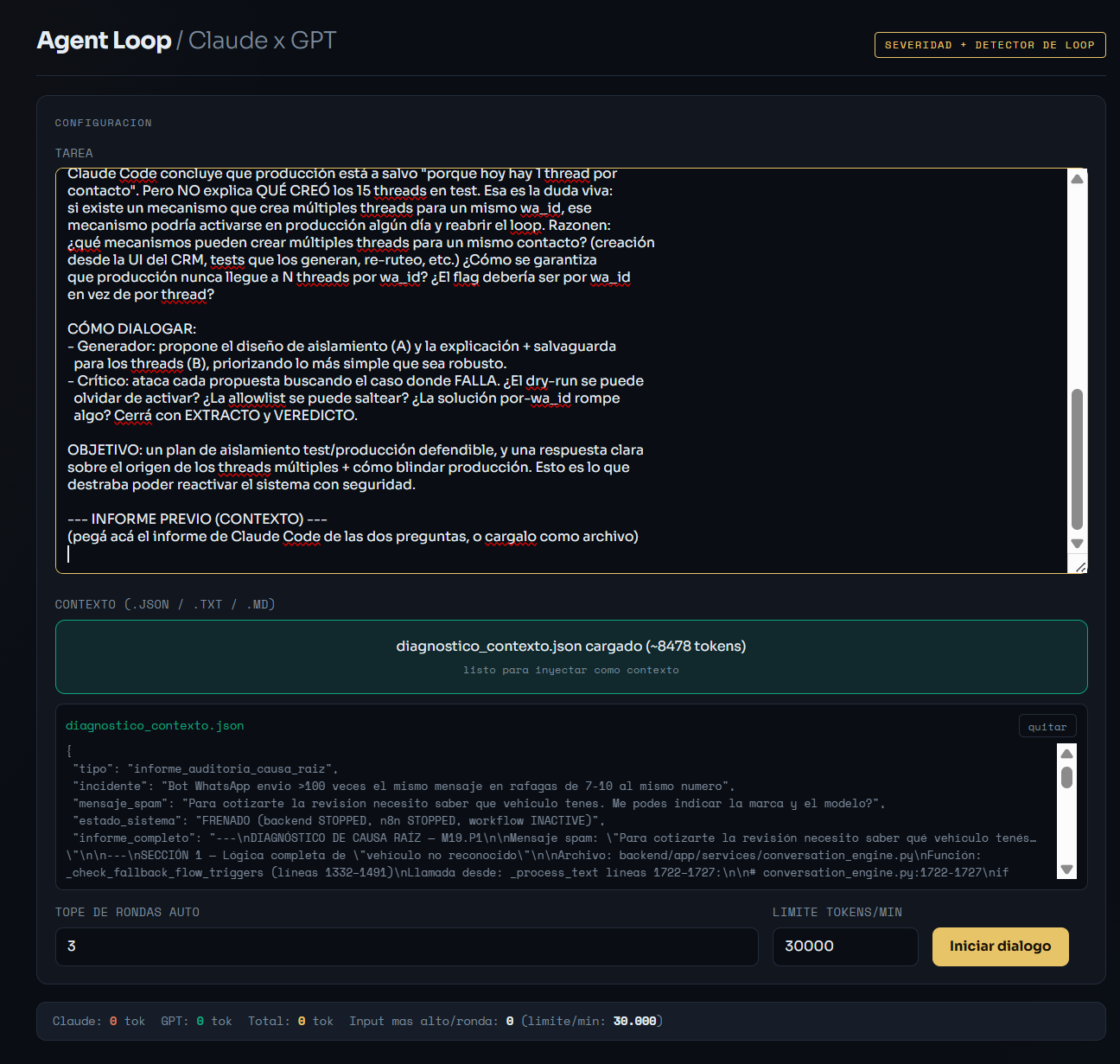
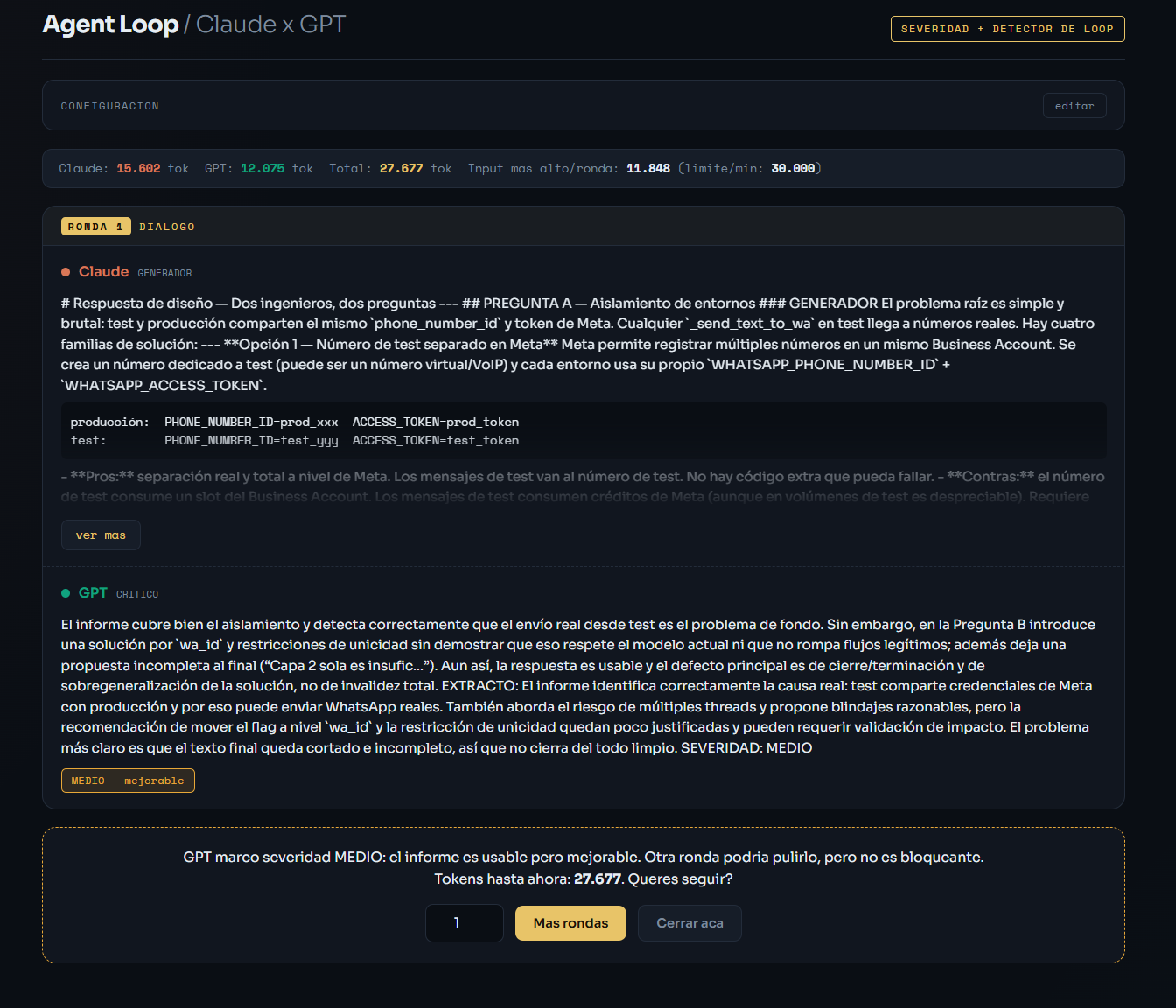
01Agent Loop's start screen: you define the task, load context, and set the round cap before running.02Task loaded with real context: a ~8,500-token diagnostic file ready to feed into both models.03The dialogue begins: the config panel collapses on its own and Claude starts generating the first proposal.04A full round: Claude proposes, GPT critiques and grades the severity as MEDIUM, and the system asks whether to continue — showing token usage in real time.05The exportable final result: critic's excerpt, consolidated report, token summary, and buttons to copy or download as .md.
Validation — a real, high-stakes case
Not a toy test. I used Agent Loop to diagnose a genuine production incident — a system sending repeated messages to a real phone number — that two AI assistants had failed to solve separately. Across several rounds of dialogue, combined with verification against the database, the system reached the actual root cause (contamination between test and production environments) and produced an actionable recovery plan.
Product vision from a real problemPrioritization & scope controlFriction-based UX iterationTechnical judgment to build & debugSystems-logic designUsing AI without delegating judgment
A commercial-operations CRM for pre-purchase vehicle inspections — integrated with WhatsApp, Instagram and n8n — that turns inbound leads into quoted and scheduled inspections with far less manual work. Not "a chatbot": a sales-operations system.
Product walkthrough
The problem
The business receives leads from people who want a used car inspected before buying. It was mostly manual: answer each lead one by one, ask for vehicle data and location, price the inspection, explain the service, follow up and schedule. People asked the same questions over and over; pricing depends on vehicle type and location (so it can't be improvised by an AI); leads arrived scattered across WhatsApp and Instagram; and there was no reliable way to know where each conversation stood.
My decisions (scope & guardrails)
The AI must never invent prices — the backend owns pricing, vehicle category, coverage and booking state.
Don't ask the full questionnaire too early: give price and availability first, detailed buyer/seller data later.
Out-of-coverage cases go to human review; tone feels like natural Argentine WhatsApp, not a rigid bot.
Don't touch production until the test environment proves the flow safely.
How I orchestrated it
FastAPI + PostgreSQL for backend and state; WhatsApp Cloud API & Flows for structured data capture; n8n for automation; OpenAI agent logic for natural replies; Docker/VPS runtime.
Directed AI coding agents (Claude Code) for implementation while I owned requirements, reviewed behavior and tested live flows.
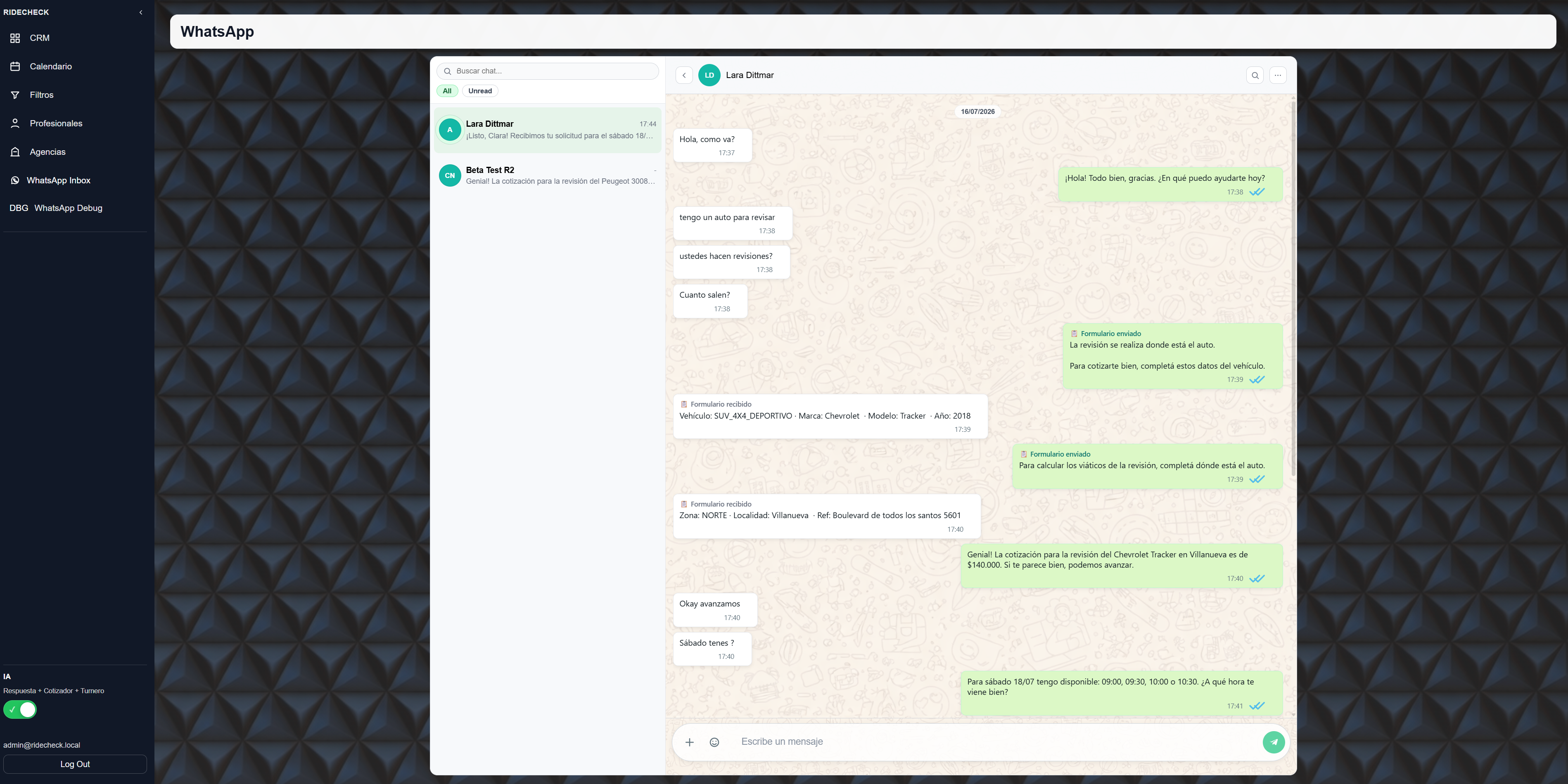
Defined acceptance criteria scenario by scenario (FAQ answers without opening a Flow; quote → Vehicle Flow → Location Flow → deterministic price → scheduling; outside CABA/GBA never gets a fake price).
Halted the live beta on a real deviation instead of forcing the test — protecting production over "finishing".
What shipped
A centralized inbox with conversation history; lead state (qualifying, quoted, scheduling, booking requested, human review); vehicle candidates; deterministic pricing; WhatsApp Flow forms; automated replies; booking-request handling; human-review flags; and the foundation for future buyer/seller matching.
Walkthrough
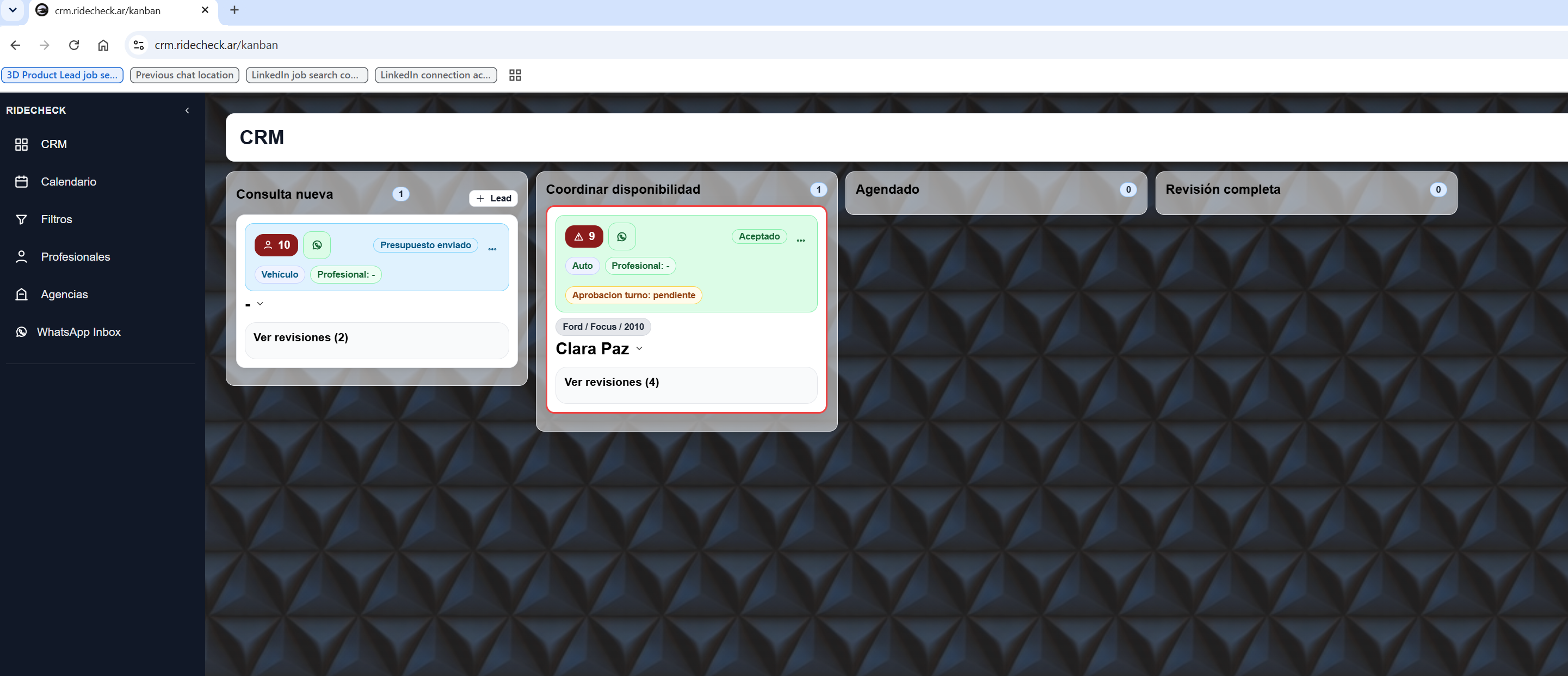
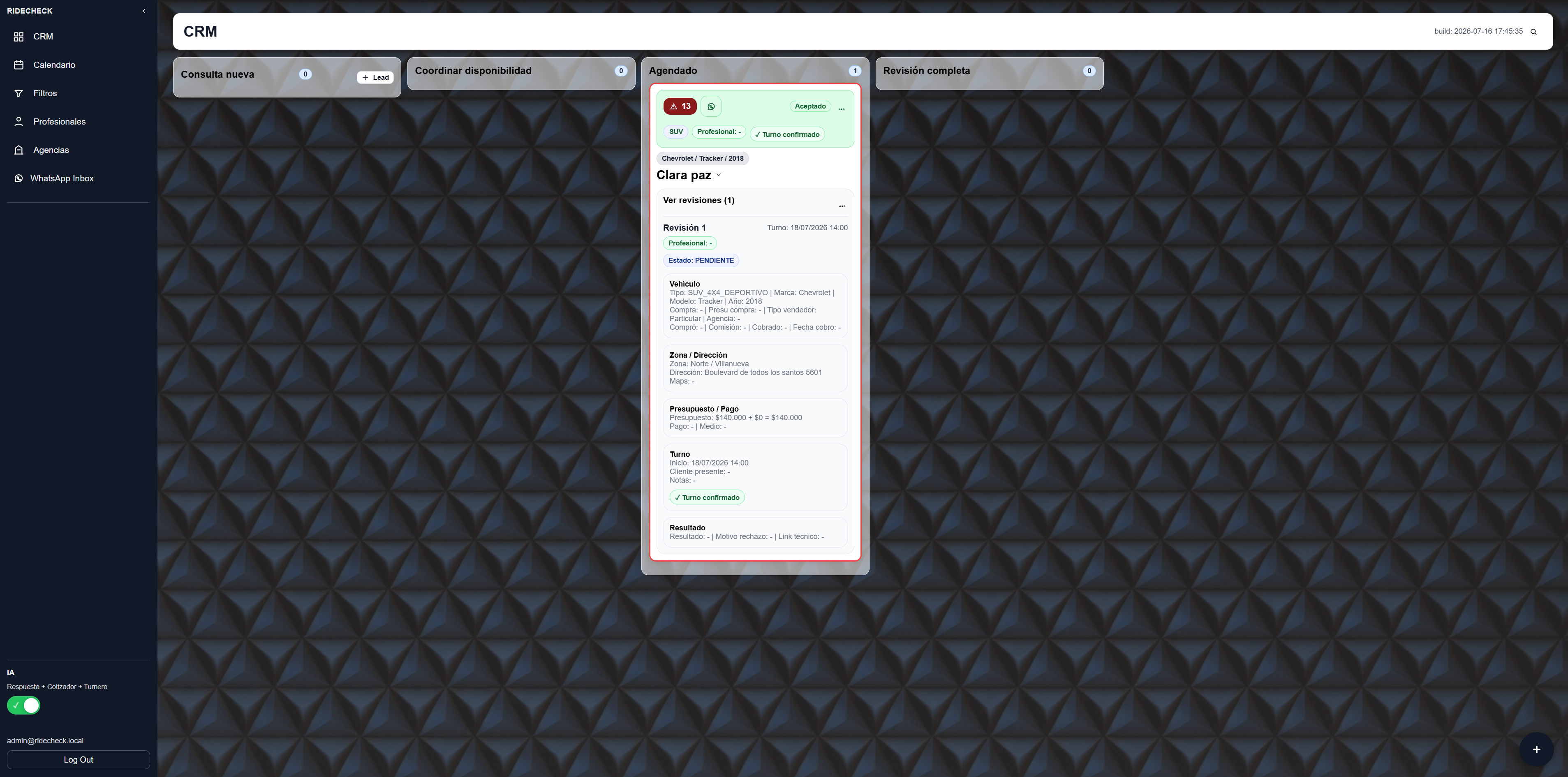
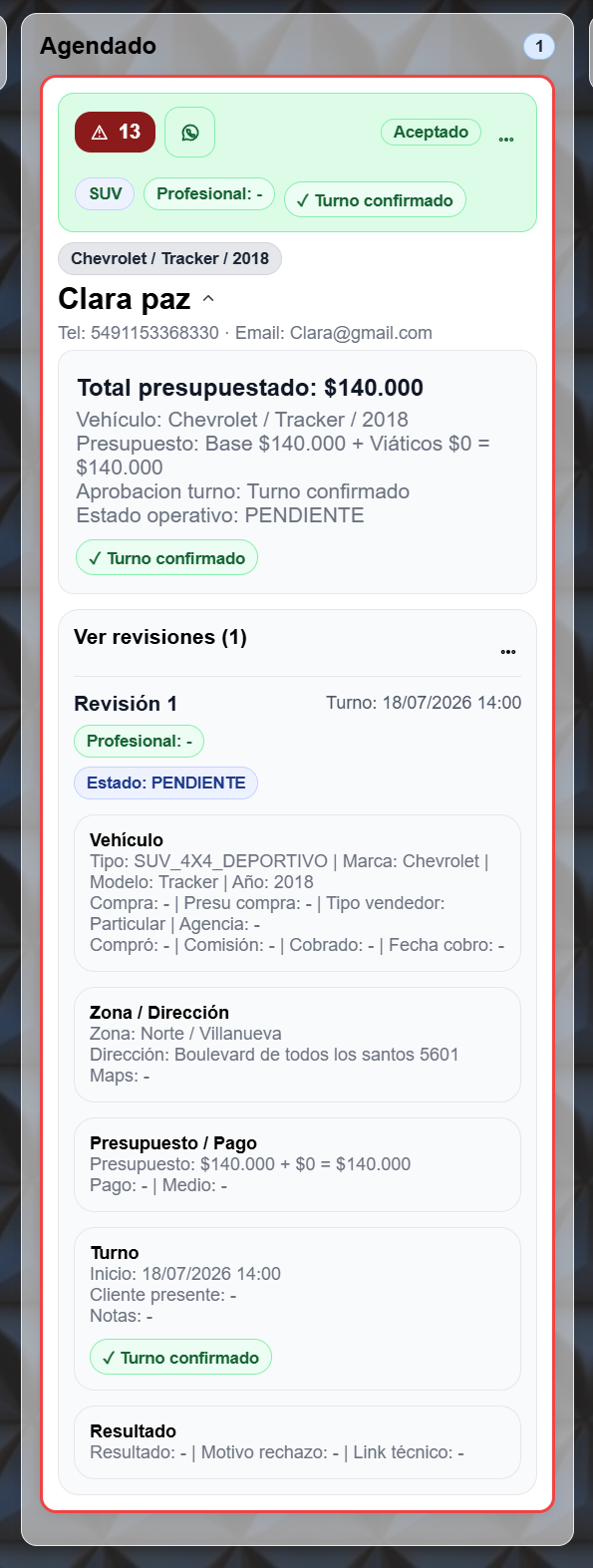
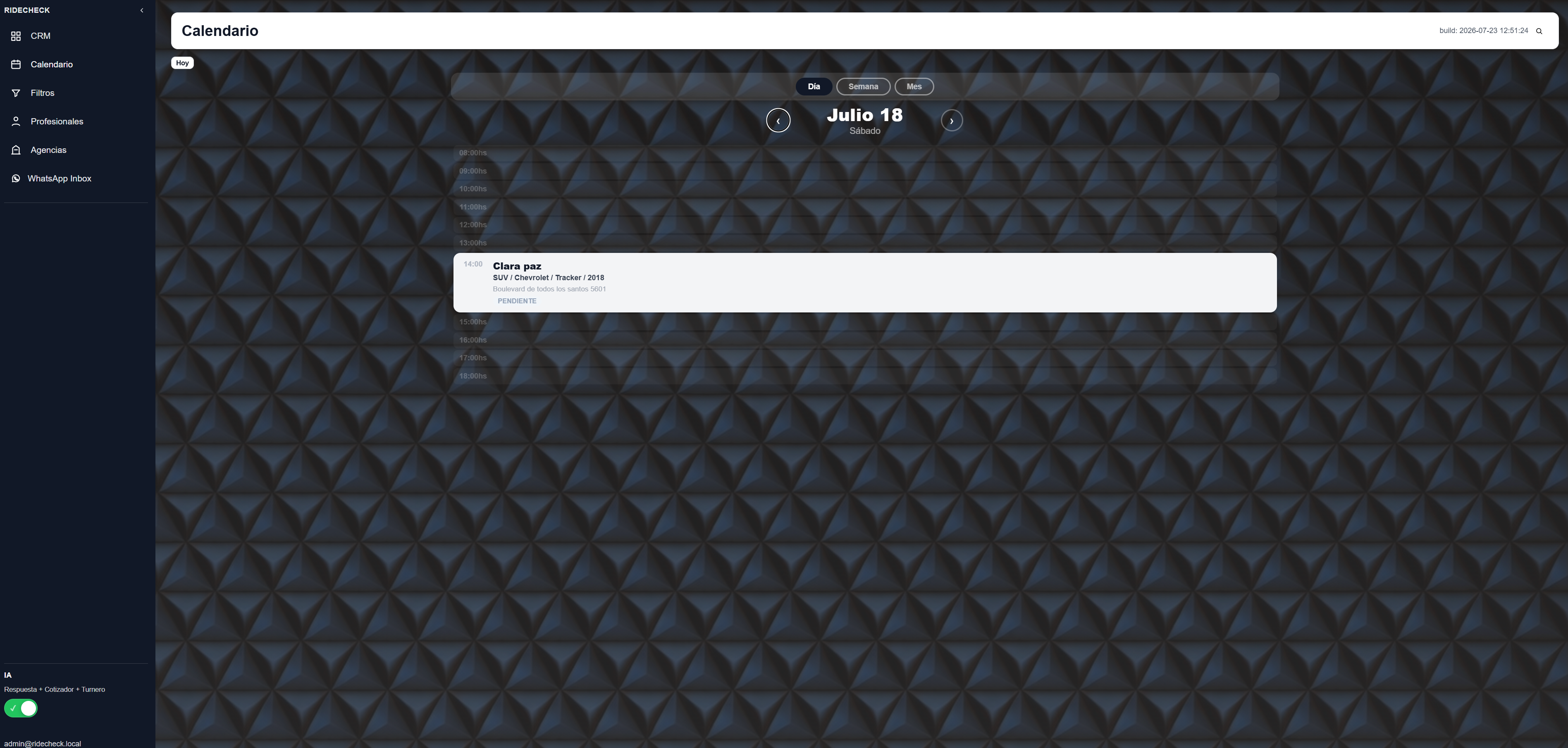
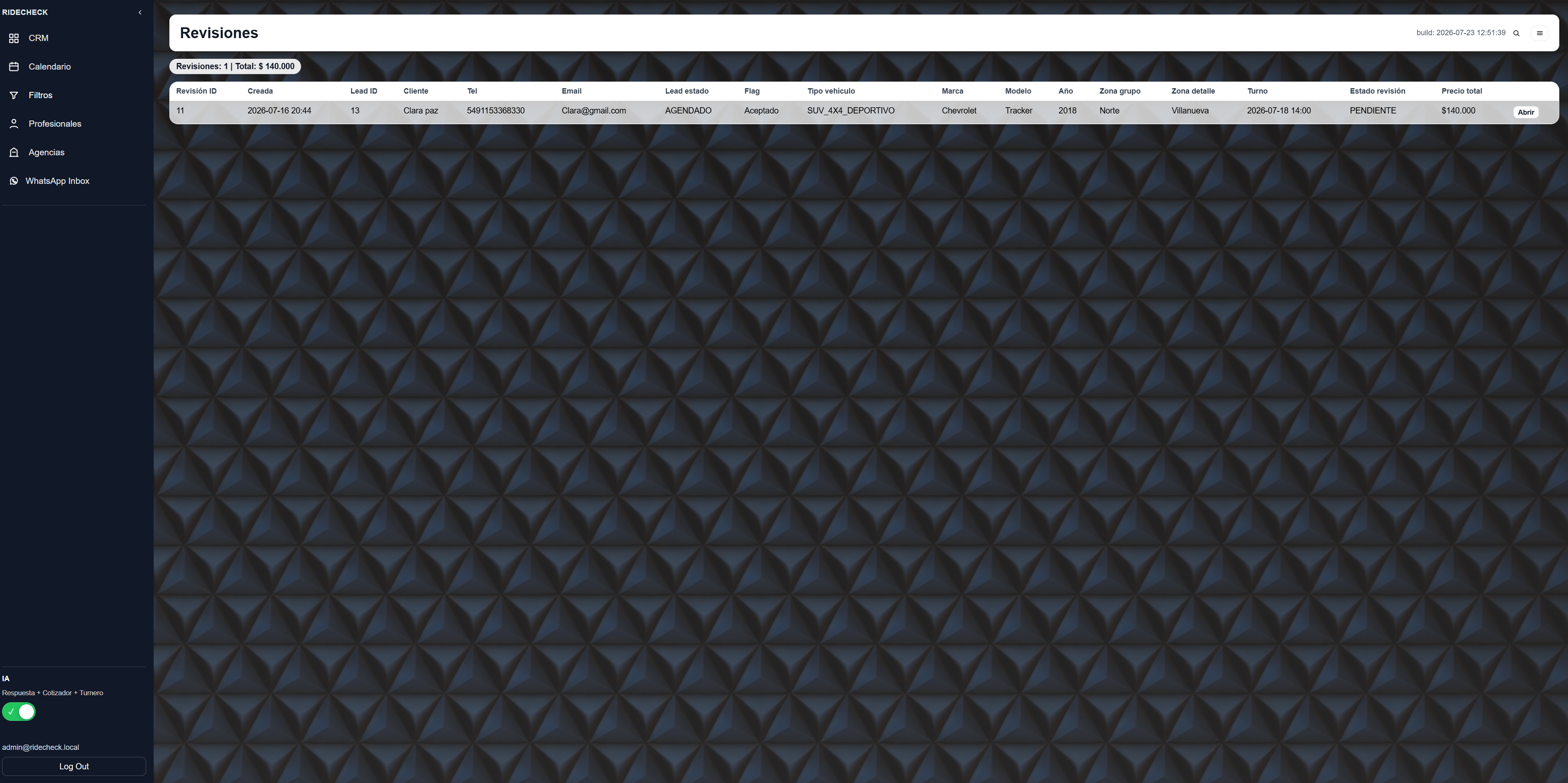
01Kanban pipeline. Leads organized by commercial stage: a new enquiry and another awaiting scheduling, with revision counts and status indicators.02Detailed revision card. A close-up of the scheduled inspection record: vehicle specs, address, quote breakdown, appointment details and pending result.03Scheduled lead overview. An expanded card in the “Agendado” stage summarizing the confirmed appointment, vehicle, location, pricing and operational status.04WhatsApp conversation. The full automated customer journey: enquiry, vehicle and location Flows, deterministic quote, acceptance and available-slot response.05Calendar view. The confirmed inspection in the daily operational calendar, with time, customer, vehicle, address and current status.06Revisions list. A consolidated table of scheduled inspections with customer, vehicle, location, appointment status and total quoted price.
Impact — controlled beta
Estimated 60–80% reduction in first-response and qualification workload for standard leads. Most CABA/GBA cases can be quoted automatically once vehicle and location are known. Scattered WhatsApp/Instagram chats are centralized into one CRM with structured lead states, making testing and scaling safer because pricing and state are deterministic — not improvised by AI. A customer can now arrive by WhatsApp, ask a question, get a natural answer, complete vehicle and location forms, receive a correct price, request a slot and generate a booking — while the CRM keeps full state and knows when a human must step in.
Product vision from a real bottleneckScope & safety boundariesAI orchestration & guardrailsAcceptance-criteria designStaged rollout & test strategyProtecting production over shipping fast
About
One thread through twenty years
I'm Lara Dittmar. For twenty years I've done one thing: turn vague ideas into real, working things. It started in industrial design and brand experiences for Nike, Netflix and Pepsi; it grew into running a studio with its own software factory, and into scaling a manufacturing operation 10× on a digital platform I built and still runs today.
Today I lead product and orchestrate AI to build and ship. I'm not an engineer competing on code — I'm the person who decides what's worth building, directs the AI and the people who build it, and has the design taste to make it good. In 2026, writing code is no longer the scarce skill. Knowing what to build, and getting it shipped, is.
How I work
What I bring
Product
Discovery, ruthless scoping, and framing decisions in metrics and outcomes.
AI orchestration
Building apps and automations with AI and no-code — directing models, not hand-writing code.
Design
Twenty years of craft and judgment. Figma, prototyping, friction-based iteration.
Leadership
Founder and operator. Directing technical teams and shipping under real pressure.
Let's build something.
Open to product roles — AI / Technical PM, Product Lead — remote or relocation. If you need someone who decides well and ships, let's talk.